
SOURCE, BACKGROUND & CIRCULATION
Thriller Dance AI: Michael Jackson, the Short Film and Its Legacy
Understand the Thriller dance background and compare it with later AI adaptations of the lead dancer and zombie crowd.
By Burning Bridges AI Video · Sources reviewed
What does Thriller Dance AI refer to?
It describes an AI adaptation of the zombie-dance imagery associated with Michael Jackson’s Thriller. The original performance and the later AI references have different production histories; use the references to compare the lead dancer, crowd and movement.
Separate the original dance background, the example’s visual style and the movement you want to create. A similar zombie look does not establish an exact choreography match.
What work does Thriller Dance refer to?
The reference is Michael Jackson’s Thriller, especially the horror imagery and group choreography of its 1983 short film. The Library of Congress names John Landis as director, Michael Peters as choreographer and Jackson as performer and co-writer. Source: Library of Congress, Michael Jackson’s Thriller, item 86708393.
The film combines music with horror storytelling. “AI Thriller” describes a later adaptation method; it does not mean the original film or dance was AI-generated.
How do we know the dance travelled beyond the film?
Guinness World Records documents a Thriller dance in Mexico City on August 29, 2009 with 13,597 participants. This is a concrete example of collective recreation long before today’s portrait-animation tools. Source: Guinness World Records, Largest Thriller dance.
The event establishes part of the older dance’s cultural life. It does not measure use of a current AI template, and an old participation record must not be presented as a current hashtag total.
What do the later examples borrow?
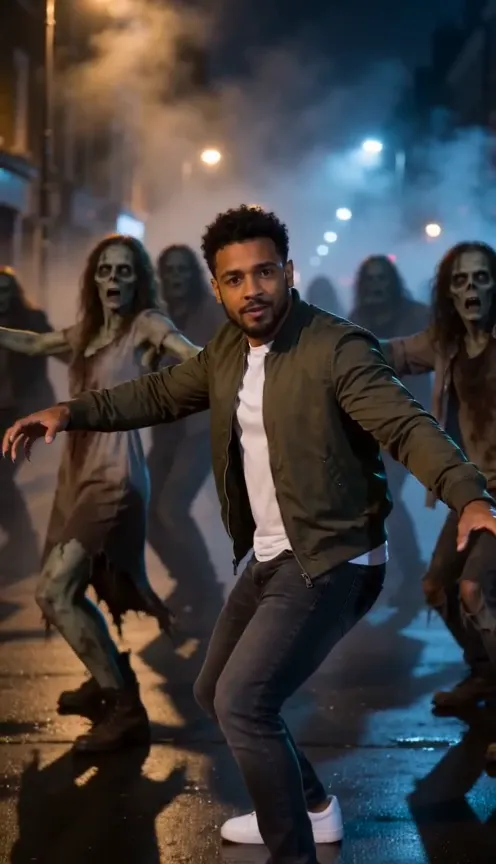
The examples place a lead in front of a group, using a dark street, horror styling and coordinated gestures to create a zombie-dance scene.
Interpretation: the lead-and-group arrangement makes a replacement performer noticeable while the crowd supplies familiar context. This helps explain the remake format without guaranteeing an exact choreographic match.
Separate a long dance legacy from an AI breakout
The evidence supports a 1983 film, a later mass recreation and current AI samples collected here. It does not establish who first made a matching AI template or when those samples reached a particular audience size.
A human tribute, a generated zombie dance and an original-film excerpt should be labelled separately. Reference music does not establish that another product includes the song or permission to publish it.
Sources and limits
Reviewed October 23, 2026. Source titles below identify the records used for historical claims; local reference footage is used only to describe the examples on this site.
- Library of Congress — Michael Jackson’s Thriller
- Guinness World Records — Largest Thriller dance
Where this article labels a point as interpretation, it explains how the format may work rather than claiming a measured cause of popularity. A documented older work or revival does not establish the first creator of every later AI adaptation.
Frequently asked questions
Is Thriller Dance based on Michael Jackson?
Yes. It refers to the song and zombie-dance imagery associated with his 1983 Thriller short film.
Are these references the original film?
No. The AI dance examples and the original Thriller film have different production histories.
Does the 2009 event prove the current AI template is viral?
No. It documents the older dance’s reach, not current AI-tool usage.