
FIRESTARTER · SONG, GAME & DANCE
What Is K/DA Firestarter? Song, Dance and AI Trend
Meet the song and virtual performers behind FIRESTARTER, then see how official choreography, dance covers and AI video adaptations relate.
By Burning Bridges AI Video · Sources reviewed
What is the Firestarter AI dance trend?
It is a photo-to-dance adaptation of the movement and visual style associated with K/DA’s FIRESTARTER. The song and official performances supply the reference; creators interpret it through human covers, edits and AI animation.
- The song: K/DA’s FIRESTARTER, with credited vocal performances.
- The movement: a routine to study in animation, choreography and dance covers.
- The AI version: a portrait or character animated around a related dance idea.
Whose song is FIRESTARTER?
FIRESTARTER is a song by K/DA, Riot’s virtual pop group connected to League of Legends. The featured singers for this release are MIYEON and SOYEON of i-dle, Sophie Powers and Mimi Webb. They are credited in the title linked from Riot Games Music’s official music links and the official FIRESTARTER music video.
The distinction matters: K/DA is the group presented on screen, while these musicians provide the real vocal performances. Calling it only an “AI dance effect” leaves out the music that the adaptations refer to.
UPI’s October 19 release report identifies the release as K/DA’s first new song in six years and reports that the animated video was made with Fortiche, the studio behind Arcane. That comeback and animation context helps explain why the release attracted attention from existing fans; it does not by itself measure social-platform virality.
What does K/DA have to do with League of Legends?
K/DA’s four virtual members are Ahri, Akali, Evelynn and Kai’Sa, all characters from League of Legends. Riot presents them as a music group with pop-star identities. The roster is stated in League of Legends’ official MORE video, and the game connection is described in the UPI report above.
Think of two layers: the familiar game characters supply the fictional performers and visual identity; real recording artists supply the vocals. FIRESTARTER therefore connects music fandom with an existing game audience. An animated character appearing in a clip is not the same thing as a real singer filming a dance cover.
The connection also extends to official player activity. Riot’s Battle of the Bands challenge asks fans to choose K/DA, HEARTSTEEL or True Damage and participate through League matches and creative challenges. It includes a FIRESTARTER-named objective. This is direct evidence of Riot linking the music campaign to the game community, rather than an unrelated dance tool borrowing a popular name.
How did Firestarter spread into dance and AI videos?
The evidence supports several ways people encountered and adapted the release. It does not establish a single first viral post or a proven chain in which every format appeared after the previous one.
1. Official music and animation gave people a shared reference
The official MV supplied the song, characters and performance imagery. UPI reported the single and video on October 19, 2026. People discussing the comeback, the music or the animation could all point to the same release.
2. An official dance video made the movement easier to study
Riot’s music hub also links an official choreography video. Its existence gives dancers a dedicated performance reference alongside the animated MV. Our interpretation: a repeatable movement reference lowers the barrier to learning a phrase, filming a cover and comparing a human performance with animation. It does not tell us which dancer first drove significant traffic.
3. Official fan activity created another participation route
The Battle of the Bands campaign explicitly invites band-inspired creative content as well as gameplay. That supplies a documented reason for fans to make and share things around K/DA. The event’s existence should not be treated as proof that it caused a particular TikTok or Reels breakout.
4. Covers, comparison edits and AI tools offer different adaptations
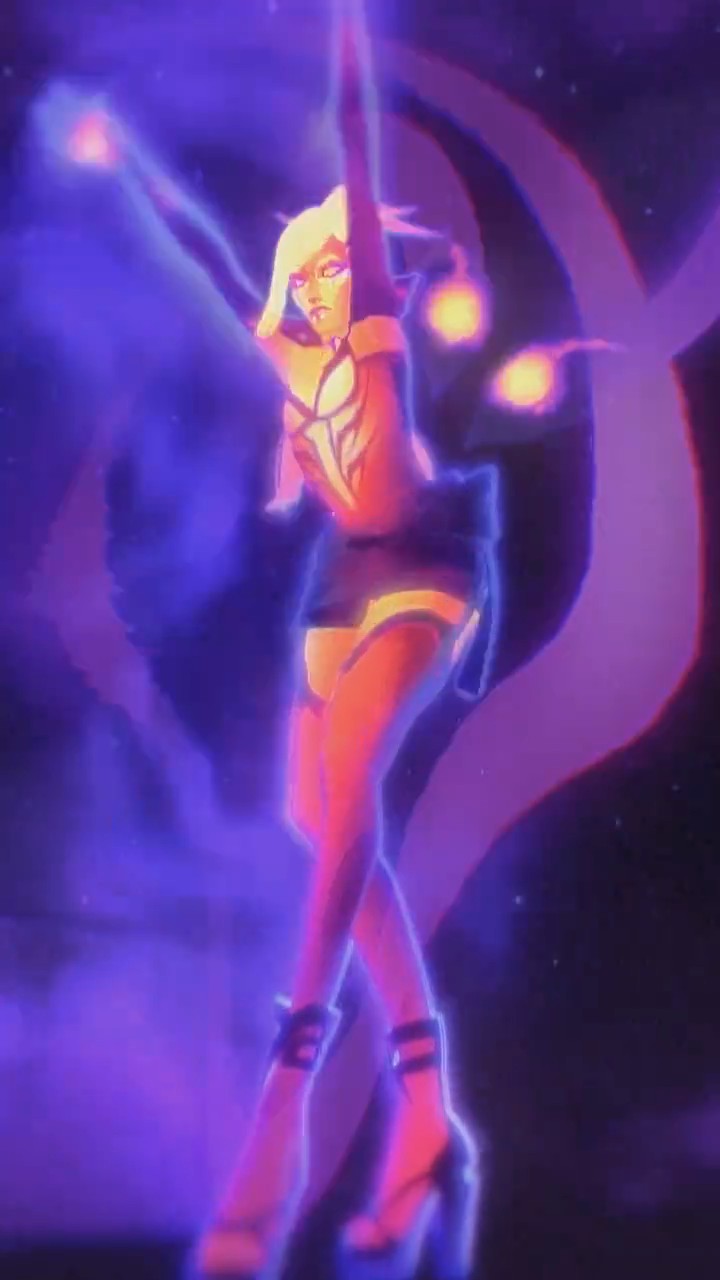
Our local collection includes a animation/live-action comparison and neon examples from. These demonstrate two adaptation formats: performing a dance and presenting a photo-to-dance AI effect. The supplied clips came without original post URLs, so they cannot identify the first creator or establish posting order.
Why is it suited to short-form dance edits?
This is an interpretation of the references, not a measured ranking of growth factors. A recognizable character or pose gives viewers something to compare across versions. A short movement phrase can be repeated by a dancer, placed beside animation or used as a target for an AI adaptation.
The glowing outlines and strong color contrast are also visually distinctive in the examples collected here. An editor can emphasize a gesture or transformation without explaining the whole music video. At the same time, the connection to K/DA gives existing fans a reason to recognize and discuss the source.
Those features help explain how the idea can travel between music fans, League players, dancers and AI-video creators. They do not prove the size of each audience or the performance of any individual post.
Where does the “AI dance” part fit?
The song, virtual group and official animation are the source context. A third-party AI dance generator is a separate creation tool that tries to animate a supplied subject in a related style or routine. The word “AI” in a template name does not mean the original K/DA release was generated by that tool.
Likewise, a human dance cover is not an AI output, and a split-screen edit does not demonstrate automatic choreography transfer. Keep these labels separate when comparing examples or choosing a workflow.
What app made the Firestarter video I saw?
You usually cannot identify the exact tool from the finished clip alone. Look for a creator disclosure, a visible watermark or a template label, then verify the tool’s own description. Similar footage may be a human cover, an animation, a face replacement or a generated dance.
The references here are not evidence that a particular model produced every version. If you want to make your own, the workflow comparison explains what inputs to check before choosing a tool.
What is confirmed, and what remains unknown?
- Confirmed: K/DA’s song and credited singers, its four League character members, an official MV and choreography video, and Riot’s game-linked fan campaign.
- Observed in this collection: animated footage, an animation/live-action comparison and third-party neon AI examples.
- Not established: the first viral dancer, the platform where the dance first broke out, a verified hashtag total, or a causal ranking of why it spread.
Sources were reviewed on October 23, 2026. This article describes the documented release and participation routes without claiming a complete viral history. Burning Bridges is independent of Riot Games, K/DA and the referenced generator. Watching reference audio does not grant a soundtrack license.
Source record: Riot Games Music official hub, FIRESTARTER official MV and choreography video, League of Legends official material, and UPI’s October 19, 2026 report. Background sources reviewed October 23, 2026; the examples on this page show dance adaptations.
Explore the dance or plan your own version
Choose what you need next: watch the Firestarter references, follow the photo-to-video steps, or compare preparation, generation and download costs.
Choose a clear portrait with room around the arms, then compare the movement and framing in the reference clips.
Frequently asked questions
Whose song is FIRESTARTER?
FIRESTARTER is a K/DA song. Riot Games Music lists MIYEON and SOYEON of i-dle, Sophie Powers and Mimi Webb as its featured vocal performers.
How is K/DA connected to League of Legends?
K/DA is Riot’s virtual pop group built around four League of Legends champions: Ahri, Akali, Evelynn and Kai’Sa. The fictional members and the real singers are different identities.
Did an AI generator create the original Firestarter song or video?
The source release is an official K/DA music project. Third-party Firestarter AI dance tools offer adaptations; they are not the origin of the song or proof that its official animation was AI-generated.
Who first made the Firestarter dance go viral?
The sources reviewed here do not establish the first viral creator, a first platform or one decisive breakout post. Official releases, a dance tutorial format and fan participation are documented, but a complete viral timeline is not.
What photo works best for a Firestarter dance video?
Use a clear portrait with one subject, an unobstructed face and room around the arms. Waist-up or full-body framing makes it easier to plan the hand gestures and body movement.
Can a TikTok clip tell me which AI app was used?
Not reliably by appearance alone. A creator disclosure, watermark or template label is a clue to verify, not proof that every similar clip uses that tool.