
FLYING ENTRANCE · HOW TO
How to Make a Flying Entrance AI Video
Plan a Flying Entrance shot with separate person and car photos. Set the foreground, airborne arrival and landing, then check depth, scale and continuity.
By Burning Bridges AI Video · Updated
1. Choose the result and workflow
Start here: Use a multi-reference or compositing workflow that supports a person and a vehicle. Build a still composition first to test scale and separation. Animate a short background movement before attempting a full airborne arrival; the vehicle should never intersect the foreground subject.
Explore what the Flying Entrance AI trend is, Flying Entrance page, then choose clear photos for your video.
2. Prepare the photo inputs
Choose a clear person photo with enough body information for the seated composition and a separate image showing the whole car. A front view can communicate the grille and body shape. Avoid cropping the wheels or mixing several cars in one input.
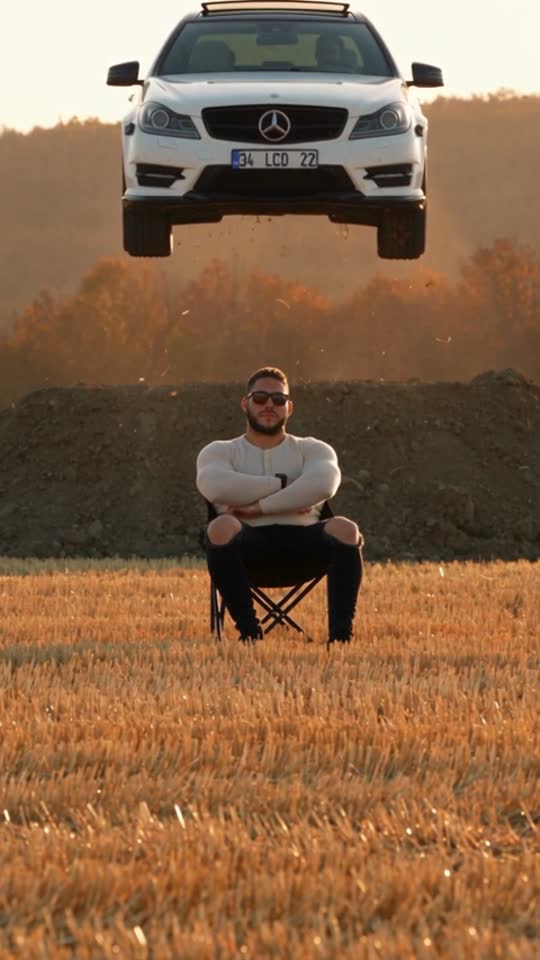
Open the local photo preparation area to inspect the selected files. Follow the format and size rules printed beside its inputs. Then check the requirements of your chosen creation tool separately; they may differ.
3. Plan a short sequence
Establish the calm foreground
Keep the seated person clearly separated from the background space. The chair and body should look stable before the vehicle appears.
Plan the car path
Choose one direction behind the person and keep the car at a consistent distance. Do not ask for multiple direction changes in the same short shot.
Resolve the entrance
Decide whether the shot ends before a landing or shows a controlled final position. An unexplained disappearance can look like an error rather than an ending.
Use these as separate composition checks. A service with multi-shot controls may accept them together; otherwise, test a short shot first and join usable clips in an editor. Do not assume a single upload supports every camera change.
4. Adapt an original starting prompt
For a compatible image-to-video tool, this is a starting idea rather than a tested preset or a guarantee of the reference choreography. Keep only the actions your selected model can handle.
Fictional cinematic scene in an open field, one adult seated calmly in the foreground and one car far behind. The car makes a short stylized airborne pass across the background while the person stays still. Preserve the face and car body shape, consistent wheels and scale, no contact with the person, fixed camera, no text.
Choose the appearance references through the tool’s supported input controls. A written instruction to preserve a face cannot replace a missing identity input. Adjust the framing to your intended output before spending credits on longer clips.
5. Review the first draft
- The car changes make or shape
- Use a clear vehicle reference and simplify the camera angle. Check the grille, wheel count and roofline across the motion.
- The car crosses the person
- Increase the depth separation in the starting composition. Keep the car path behind the chair rather than describing a close pass.
- The scale jumps mid-shot
- Reduce the distance traveled or use a fixed camera. A moving camera and moving vehicle can make perspective harder to control.
6. Edit, check sound and export
Trim the start and ending so the sequence has a clear setup and a settled finish. Avoid using an elaborate transition to hide a face or hand error: compare a simpler shot first. If several clips are joined, check screen direction and identity on both sides of every cut.
Use audio you are entitled to use and inspect the actual export. Check whether the tool includes audio, allows downloads and adds a watermark before rendering. The Flying Entrance free-method guide gives an editing alternative when you prefer to avoid paid AI tests.
Use a miniature or storyboard for the cheapest way to test the gag. For a generated version, verify two-reference support and focus on depth and vehicle shape. Real stunt footage is not required to plan the effect.
Reference and method notes
Reviewed October 22, 2026. Visual observations describe the references collected on our Flying Entrance page, rather than every version posted elsewhere. This guide does not claim an original upload date, a popularity ranking or a tested external render. The prompt above is original planning guidance; no external generation was run for this article.
Frequently asked questions
Does the reference audio come with every result?
No such promise is made here. Check the selected tool’s audio and export terms, and use audio permitted for your intended post.